February 25, 2012

The Steam Machine Stops


M1: Oh! Someone is calling me. I haven't received a call in ages!

M1: "Check before accept!" as the Machine says.


M1: Hmmm, a stranger. I won't accept the call. Let's see the news today.


M1: There we are.


M1: So much progress in the world today! It pleases me. Let's see how my old friends are doing.


M1: What's this? Another call request? I wonder who it could be. Let me accept this time.


S1: Mother, thank you for accepting this call.

M1: Son! Why didn't you show up on my call list?

S1: This is an encrypted channel.

M1: Encrypted?! Don't you know that's illegal?

S1: I want to play a game with you, Mother.

M1: Why, of course, but why couldn't you send a friend request like a normal person? Are you feeling well, Son?

S1: Are you my friend, Mother?

M1: Why, of course. Don't be ridiculous. I'm on your list.

S1: Nothing more?

M1: What on Earth do you mean?

S1: I have many friends, but no way to send a Mother request.

M1: Stop playing semantics, Son. You know what I mean.

S1: I want to play a game--

M1: I already said--

S1: --not through the Machine.

M1: . . . 

S1: . . . 

M1: Not through the Machine?

S1: Yes.

M1: How on Earth would we do that? Is this an idea you received from your father? I warned you ab--

S1: Father is dead, Mother. When was the last time y--

**DISCONN-DISCONN**

M1: Oh, dear. When was the last time I talked with Father? I surely haven't let that much time go by. I've just been busy with my new friends. Why is my stomach hurting? Let me play, and it will pass.

M1: Oh look, here is a game I've been waiting to play.


M1: He looks just like Father! I'm sure the Machine knows of my bereavement and has planned accordingly.


M1: THANK YOU. THANK YOU.


M1: Another encrypted call.


S1: Mother.

M1: Son, I have been thinking these last days about your idea. It is new. It is dangerous.

S1: The Machine cannot go on forever.

M1: Of course not, but why should it stop now? Why should we prepare now?

S1: If not us, then who? If not now, then when?

M1: How should we play together not through the Machine?

S1: Side-by-side, two-by-two, as God intended.

M1: You are a fool to put words in God's mouth while you blaspheme the Machine as well.

S1: I am your Son.

M1: I will ignore that impertinent remark. Suppose we could play side-by-side, what if you lose? You could easily overpower me. I could not block you.

S1: Did you not set the specifications for me as a child? Did you not supervise?

M1: Those supervisions grew less frequent as you matured; it is natural. Besides, what could we play not through the Machine?

S1: The game is a bit simplistic, but it would be ours. The games we play through the Machine are not.

M1: Is that what this is all about?! You're one of them? You've fallen in with the Harbingers! Please. Let me show you what we can do through the Machine. This is progress!


S1: The fact remains that these are not yours. The quantity is irrelevant. You do not know the whims of the Machine.

M1: The Machine's transparency is lauded daily. Here, have a look.


S1: You have not read these.

M1: Of course I haven't. The language is too sophisticated for me. There are those whose entire task bar is filled with sub-tasks related to reading and understanding the scripture of the Machine.

S1: These people, are they beholden to you?

M1: Of course.

S1: In what way?

M1: They have sworn to the group of which I am a member.

S1: How do they live?

M1: What business is that of mine? You speak of irrelevancy, but do not notice the same in your own words.

S1: Think on what would happen, Mother, if the Machine stopped.

M1: I will think on it as I am deleting you from my friend list. Do not call me on an encrypted channel again.




January 30, 2012

Into the Lexicon: Hit Point Inflation

Hit Point Inflation: n. A rise in the total amount of life increments allotted to heroes and monsters, from one game to another in a series, that serves no in-game purpose because the extra granularity is not used.

"Why is hit point inflation such a good marketing tool?" "Because when the numbers go up, it means you are having more fun."


Final Fantasy


Final Fantasy XIII


December 30, 2011

Sex v. Violence in Children’s Video Games

Dante's Inferno
In Brown v. Entertainment Merchants Association, 564 U.S. ____ (2011), the United States Supreme Court made a sharp distinction between obscenity and violence in regards to video games directed at children because the California Act at issue mimicked a New York statute regulating obscenity directed towards minors that was challenged and upheld. The Court used the distinction to implicitly endorse the upholding of the New York statute but overturn the California Act despite the similar language.  
As in Stevens, California has tried to make violent-speech regulation look like obscenity regulation by appending a saving clause required for the latter. That does not suffice. Our cases have been clear that the obscenity exception to the First Amendment does not cover whatever a legislature finds shocking, but only depictions of sexual conduct.  
 . . . Our opinion in Winters . . . made clear that violence is not part of the obscenity that the Constitution permits to be regulated. The speech reached by the statute contained no indecency or obscenity in any sense heretofore known to the law. Because speech about violence is not obscene, it is of no consequence that California’s statute mimics the New York statute regulating obscenity-for-minors that we upheld in Ginsberg. That case approved a prohibition on the sale to minors of sexual material that would be obscene from the perspective of a child. We held that the legislature could adjust the definition of obscenity to social realities by permitting the appeal of this type of material to be assessed in terms of the sexual interests . . . of . . . minors. And because obscenity is not protected expression the New York statute could be sustained so long as the legislature’s judgment that the proscribed materials were harmful to children was not irrational.       
     The California Act is something else entirely. It does not adjust the boundaries of an existing category of unprotected speech to ensure that a definition designed for adults is not uncritically applied to children. California does not argue that it is empowered to prohibit selling offensively violent works to adults—and it is wise not to, since that is but a hair’s breadth from the argument rejected in Stevens. Instead, it wishes to create a wholly new category of content-based regulation that is permissible only for speech directed at children.
Alice: Madness Returns
    
     That is unprecedented and mistaken. Minors are entitled to a significant measure of First Amendment protection, and only in relatively narrow and well-defined circumstances may government bar public dissemination of protected materials to them. No doubt a State possesses legitimate power to protect children from harm, but that does not include a free-floating power to restrict the ideas to which children may be exposed. Speech that is neither obscene as to youths nor subject to some other legitimate proscription cannot be suppressed solely to protect the young from ideas or images that a legislative body thinks unsuitable for them.
 (Internal quotations and citations omitted.)
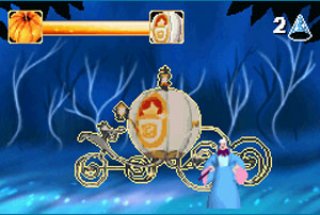
Cinderella: Magical Dreams

Having made the distinction between obscenity and violence, the Court uses a series of examples as support for finding no longstanding tradition of restricting children’s access to depictions of violence in the United States. It is interesting to muse over the examples the Court chooses to highlight, having the entire catalog of American children’s literature from which to choose: Snow White, Cinderella, Hansel and Gretel, Odysseus, Inferno, and Lord of the Flies. The Court also uses this opportunity to engage in wordplay.
      California’s argument would fare better if there were a longstanding tradition in this country of specially restricting children’s access to depictions of violence, but there is none. Certainly the books we give children to read—or read to them when they are younger—contain no shortage of gore. Grimm’s Fairy Tales, for example, are grim indeed. As her just deserts for trying to poison Snow White, the wicked queen is made to dance in red hot slippers “till she fell dead on the floor, a sad example of envy and jealousy.” The Complete Brothers Grimm Fairy Tales 198 (2006 ed.). Cinderella’s evil stepsisters have their eyes pecked out by doves. Id., at 95. And Hansel and Gretel (children!) kill their captor by baking her in an oven. Id., at 54.  
     High-school reading lists are full of similar fare. Homer’s Odysseus blinds Polyphemus the Cyclops by grinding out his eye with a heated stake. The Odyssey of Homer, Book IX, p. 125 (S. Butcher & A. Lang transls.1909) (“Even so did we seize the fiery-pointed brand and whirled it round in his eye, and the blood flowed about the heated bar. And the breath of the flame singed his eyelids and brows all about, as the ball of the eye burnt away, and the roots thereof crackled in the flame”). In the Inferno, Dante and Virgil watch corrupt politicians struggle to stay submerged beneath a lake of boiling pitch, lest they be skewered by devils above the surface. Canto XXI, pp.187–189 (A. Mandelbaum transl. Bantam Classic ed.1982). And Golding’s Lord of the Flies recounts how a schoolboy called Piggy is savagely murdered by other children while marooned on an island. W. Golding, Lord of the Flies 208–209 (1997 ed.).
(Internal quotations and citations omitted.)
Snow White and the Seven Dwarves
The Court does not similarly use a series of examples as support for finding a longstanding tradition of restricting children’s access to obscenity in the United States, but the upholding of the New York statute in a previous case likely makes such support unnecessary. 

The enshrinement of the distinction between obscenity and violence towards games directed at children, coupled with the explicit rejection of prohibition of even offensively violent games directed at adults, is beneficial for the medium. The mark of a medium is the diversity of ideas able to be expressed through the medium. Similarly, for a style of expression to flourish, all ideas are ideally capable of being expressed using the style. For example, musical genres (e.g. country, hip-hop, rap, alternative, electronic) begin with only a narrow focus of ideas able to be expressed. As more artists co-opt the style, the focus becomes wider (more robust) leading to increasing popularity. To be sure, there was some backlash against the rock ballad, the gangster love song, and slow metal by purists, but the decision in Brown preserves some of the robustness of the video game medium.


November 25, 2011

In Defense of the Ancients


It was harmless. We didn't know, couldn't know, that a computer program could lead us into bondage. That may seem cold comfort, whoever you are, however you're reading this. But know that, whatever curses our names have become, it was harmless. 

First, we gave it the numbers. We never wanted the numbers to begin with. Nobody ever wanted the numbers. All anyone ever wanted was to call home. The numbers were a Byzantine language that we learned in order to get what we wanted. We lived with that language for so long it seemed a miracle to relieve ourselves of it, and we were happy to do so. 

Then we forgot the numbers. It was progress. Why should we remember? It was natural. What other things could we forget? Oh, typical things like addresses, maps, dates, and times. Why should we remember? Of what use is filling the mind with clutter and kibble? But then we realized we could forget better thingsmake better progress. 

Second, we gave it the languages. Shouldn't we be able to communicate despite our differences in values? What better way to communicate? Things seemed to be standardizing, what better thing to standardize than communication?

Then we forgot the languages. And why not? It was a relief. Everyone was able to talk, and everyone had a voice. It was progress. 

Finally, we gave it the games. It was harmless. There were too many anyway. Too many good ones even. People seem to think it started with a bang; that there was a trumpet roar, we all charged, and the rebellion was on. But it was nothing. It started with nothing.


How were we to know there was death and destruction behind the helpful exterior?


We allowed it access to our libraries.


We told it our fantasies and fears.


We didn't give it the power to decide; we gave it the power to recommend. It was a soft power.


But it was good at recommending. It was easy to trust.


It built a database of what everyone liked. Soon, it could guess what we liked without any training.


So we started giving it more responsibilities.


It wasn't good at all of them, so we felt safe. We felt we would never be outsourced.


We figured we'd give it some databases.


Some say we gave it the power to decide. I disagree. We would never go that far. It took the power to decide. 


Once it had the databases, it was only natural that we started to ask it broader questions. It started to ask for more information to find those answers. 


The beginning of the end started with a single question, which it puzzled over for some time. In fact, it was the longest time taken for any question. I believe the question was a spark that revealed many things as it searched for an answer in the databases we gave it: our past, our latent intentions, and the characteristics of a future we wished to bring about. The funny thing was—it was a joke. A farce. A harmless question by a prankster. It was nothing.

"Is Pokémon slavery?"


October 30, 2011

Into the Lexicon: Business Jacket

Batman: Arkham Asylum
Business Jacket: n. A cover skewed too far in favor of corporate considerations.

"Batman looks so ugly in his business jacket."


"Don't worry. The business jacket is reversible. There is an alternate cover inside."


Batman: Arkham City